

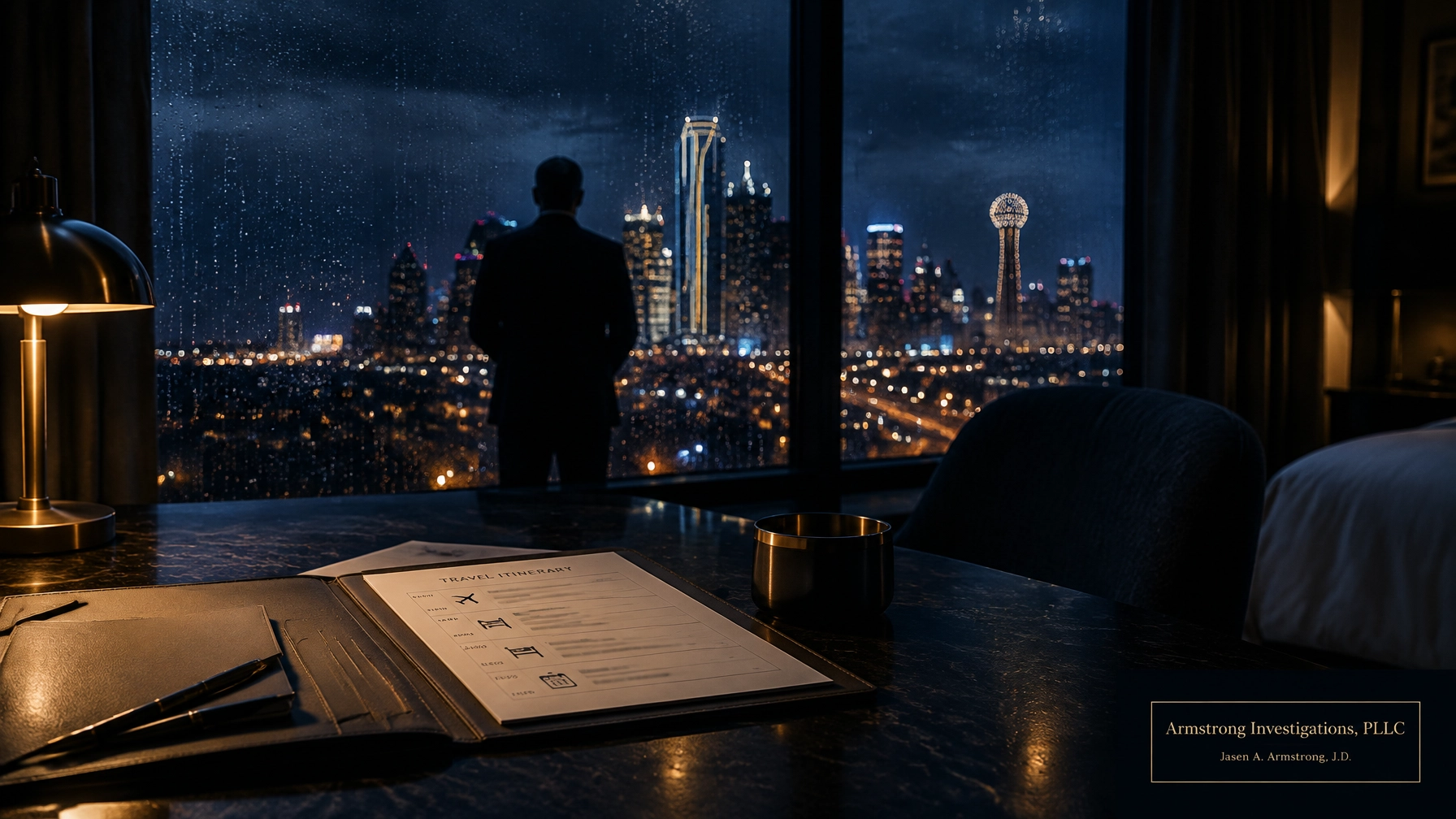
Business travel can create distance in a relationship, but it can also create a trail of dates, locations, reservations, mileage, receipts, and observable activity. When those details do not appear to match the stated purpose of a trip, a carefully planned infidelity investigation may help clarify what happened.
That does not mean every unexplained hotel charge or late-night message proves an affair. Business travel is complicated. Meetings run late, flights change, coworkers share meals, and expense reports are sometimes incomplete. The purpose of a professional investigation is not to jump to a conclusion. It is to separate assumptions from documented facts using lawful, professional methods.
For families in Dallas, Fort Worth, and throughout the DFW Metroplex, business-travel investigations often involve more than simply watching a hotel. A DFW private investigator may examine the timeline surrounding a trip, identify inconsistencies in information already lawfully available to the client, and conduct discreet surveillance from lawful vantage points when appropriate.
Why business travel can be difficult to evaluate
A typical business trip may involve several overlapping systems:
- Airline reservations and schedule changes
- Conference registrations
- Hotel stays and loyalty-account activity
- Rental-car agreements and mileage
- Corporate expense reports
- Credit-card or bank charges
- Calendar entries and meeting schedules
- Public social-media activity
- Restaurant, entertainment, or event receipts
- Phone and digital records that a client is lawfully authorized to access
Each item may appear ordinary on its own. The useful information often comes from comparing the items against one another.
For example, a person may report attending a conference in Fort Worth from Tuesday through Thursday. A review of lawfully available records may show a hotel stay beginning Monday, a rental car returned Friday, and expenses in a different part of the Metroplex during conference hours. That discrepancy does not automatically establish infidelity. It may, however, identify questions that deserve further review.
A professional investigator documents the discrepancy without overstating what it means.
What a DFW infidelity investigation can actually document
The scope of an investigation depends on the facts, the client’s lawful access to records, the subject’s travel schedule, and the locations involved. In general, a private investigator may be able to document the following.
1. Travel timelines and location patterns
The first step is often building a clear timeline.
A DFW private investigator may organize known information into a sequence such as:
- Departure from a residence or workplace
- Arrival at Dallas Fort Worth International Airport
- Attendance at a conference or business meeting
- Travel to a hotel, restaurant, or other public location
- Meetings with identifiable individuals in public
- Overnight stays or returns to a listed hotel
- Departure from the destination
- Return to Dallas, Fort Worth, or another North Texas location
This timeline may reveal whether the subject’s movements were consistent with the stated itinerary. It may also show repeated patterns across several trips.
For example, recurring travel to the same conference city is not inherently suspicious. A repeated pattern of unexplained additional nights, unreported stops, or meetings unrelated to the stated business purpose may justify closer examination.
The investigator’s job is to record what can be verified, not to label every inconsistency as misconduct.
2. Publicly observable meetings and movements
Professional surveillance may document conduct that occurs in public or from a lawful vantage point. Depending on the assignment, this can include:
- Leaving a hotel
- Entering or exiting a restaurant
- Meeting another person in a public parking area
- Traveling between a conference venue and another location
- Entering a public event or entertainment venue
- Returning to a hotel
- Departing with another person in a vehicle
- Repeated visits to a particular business or residence
The focus is generally on time, location, sequence, and observable activity. A report may include photographs or video when appropriate, along with investigator notes describing what occurred.
A private detective should not trespass, enter restricted areas, access hotel rooms, or attempt to obtain private communications through unauthorized means. Surveillance services should be planned around lawful observation, not intrusion.
In the DFW area, assignments may involve hotel and conference corridors in Dallas, Fort Worth, Irving, Arlington, Grapevine, Plano, Frisco, Addison, Richardson, or McKinney. Travel between counties can also matter. A timeline may cross Dallas, Tarrant, Collin, Denton, Rockwall, Ellis, Kaufman, or Johnson County depending on the subject’s home, workplace, and destination.

3. Hotel-related inconsistencies
Hotel information can be useful, but access matters.
A client may already have lawful access to certain records through a shared account, jointly available financial statements, or documents voluntarily provided to the household. Other information may require a formal legal process handled through family-law counsel.
Potentially relevant details can include:
- Check-in and check-out dates
- Additional nights not reflected in the stated itinerary
- Charges for parking, room service, or restaurants
- Repeated stays in the same hotel or area
- Hotel locations that do not match the conference location
- Loyalty-account activity that conflicts with the reported trip
- Separate reservations or travel dates shown in records the client lawfully possesses
A hotel bill is not a relationship conclusion. It is a record of a transaction. A repeated stay may be explained by a work assignment, a canceled flight, or a personal preference. The investigator may use the information to identify what should be corroborated through observation or other lawful research.
Investigators should not impersonate the subject, misrepresent their identity to hotel staff, obtain protected account information without authorization, or attempt to access password-protected loyalty accounts.
4. Rental-car details and mileage
Rental-car records can help compare a stated business itinerary with actual travel, but they must be obtained lawfully.
Depending on the client’s access and the legal posture of the matter, potentially relevant information may include:
- Rental dates
- Vehicle pickup and return locations
- Contracted mileage
- Mileage overages
- Fuel charges
- Toll activity available to an authorized account holder
- Vehicle class or type
- Travel dates that extend beyond the reported business schedule
Suppose a trip is described as a two-day conference in downtown Dallas, but the available records reflect a rental vehicle kept for five days and returned near Fort Worth. That may be worth examining. It still does not explain the reason for the extra days by itself.
An investigator may compare the records with public-location surveillance, receipts already in the client’s possession, conference schedules, and other lawful information. The objective is to build a reliable chronology rather than create a dramatic story from one unexplained charge.
5. Expense-report inconsistencies
Expense reports can be especially important in business-travel investigations because they may provide both dates and descriptions.
Potential areas for comparison include:
- Meals listed for one person when multiple people were observed
- Restaurant locations far from the conference venue
- Charges during times the subject reported being in meetings
- Repeated entertainment expenses
- Gifts or purchases not consistent with the stated business purpose
- Hotel charges that do not match the reported nights
- Mileage claims that conflict with rental-car or travel records
- Expenses submitted for dates when the subject was reportedly elsewhere
This information should be treated as a lead, not proof. A dinner receipt does not identify every person present. An expense description may be incomplete. A reimbursement entry may have been submitted incorrectly.
A professional investigator can help organize these details and identify which inconsistencies are worth verifying. If corporate records are needed but are not already available to the client, the appropriate method may involve formal requests or discovery through family-law counsel, not unauthorized access to an employer’s systems.
How professional surveillance fits into the investigation
Business-travel surveillance is often most effective when scheduled around specific, verifiable events rather than conducted randomly.
A client may know that the subject is scheduled to attend:
- A conference in downtown Dallas
- A trade event near the Las Colinas area
- A client dinner in Fort Worth
- A training session in Plano
- A multi-day meeting near DFW Airport
- A work assignment involving hotels in Denton, Rockwall, or another North Texas community
That information allows the investigator to assess whether surveillance is practical and what questions it may answer.
Professional surveillance may begin at a lawful public location near a conference venue, restaurant, hotel exterior, business, or parking area. The investigator documents visible activity, travel, meeting patterns, and timing. The work may involve more than one investigator when safety, distance, or traffic conditions make that appropriate.
A written report may include:
- Date and time entries
- Locations visited
- Vehicle descriptions
- Observed interactions
- Photographs or video of visible activity
- Travel direction and sequence
- Gaps or limitations in observation
- A factual summary without speculation
No investigation can guarantee a particular result. The subject may change plans, use private locations, or follow an itinerary that is entirely legitimate. Sometimes the result is documentation that a concern was unfounded. That can be valuable, particularly when uncertainty is creating conflict at home.

What a professional cannot lawfully do
A lawful infidelity investigation does not include breaking into accounts, installing spyware, secretly accessing messages, impersonating another person, or placing a tracking device where the investigator or client has no legal authority to do so.
Avoid:
- Guessing or bypassing passwords
- Entering a spouse’s private email or cloud account without authorization
- Installing monitoring software on a phone
- Placing a GPS tracker on a vehicle without legal authority
- Obtaining protected hotel or employer records through deception
- Trespassing onto private property
- Recording private conversations in violation of applicable law
- Confronting the subject during surveillance
- Following someone in a way that creates a safety risk
If a matter may become a divorce, custody, or property dispute, speak with family-law counsel about how records should be preserved and obtained. A pre divorce investigation should be planned carefully so that evidence is not compromised by improper collection methods.
Preparing for a business-travel investigation
Before contacting a private investigator, organize information you already possess lawfully. Useful materials may include:
- A list of relevant business trips and dates
- Conference names and locations
- Travel itineraries sent to a shared account
- Joint credit-card or bank records
- Receipts or expense information you are authorized to access
- Vehicle descriptions and license-plate information obtained lawfully
- A factual log of concerns, without conclusions
- Upcoming travel dates that may be relevant
Do not alter original records. Keep copies in a secure location and note when each document was received. Avoid sending sensitive information through unsecured channels unless the investigator provides instructions for doing so.
The more specific the assignment, the more efficiently an investigator can evaluate it. “Watch every trip” is difficult to price and plan. “Review the records from three recent trips and assess whether surveillance during the next Dallas conference is practical” is more focused.
How much does a private investigator cost?
Private investigator cost varies based on the number of investigators, hours required, travel distance, traffic, overnight work, destination cities, equipment, reporting needs, and the complexity of the assignment.
A short surveillance period near one DFW location may require a different budget than a multi-day assignment involving Dallas, Fort Worth, and travel outside North Texas. Records organization and public-record research may also be priced differently from field surveillance.
Our guide to private investigator cost in Dallas, Texas provides additional planning information. During a consultation, ask what is included, whether there is a minimum number of hours, how travel time is handled, and what type of report or media will be delivered.
Choosing a DFW investigator
When comparing a private investigator Dallas or private investigator Fort Worth service, look for clear answers about:
- Texas licensing and professional experience
- Lawful surveillance practices
- Confidential communication
- Documentation standards
- Geographic coverage across the DFW Metroplex
- Billing structure and minimums
- How reports, photographs, and video are delivered
- Whether the investigator understands family-related investigations
Armstrong Investigations, PLLC provides Texas private investigations and professional surveillance for clients seeking clear, responsibly documented information. Our surveillance approach is built around planning, lawful observation, accurate records, and practical communication.
You can also review how to choose a DFW private investigator before scheduling a consultation.
Suggested internal links
- Our Services, Overview of investigative services
- Family Law and Domestic Investigations: Related family and domestic investigation topics
- Private Investigator Cost in Dallas, Texas: Budget and planning considerations
- A Tech-Forward Approach to Surveillance, How surveillance planning and documentation work
- How to Choose a DFW Private Investigator: Questions to ask before hiring an investigator

Frequently asked questions
Can a DFW private investigator follow someone on a business trip?
Potentially, yes. A licensed investigator may conduct surveillance from lawful locations and document publicly observable activity. The plan depends on the destination, schedule, travel distance, and legal considerations. Surveillance does not include trespassing, unauthorized account access, or intrusive monitoring.
Can an investigator obtain hotel loyalty records?
Only when the records are lawfully accessible or obtained through an appropriate legal process. A private investigator should not impersonate the subject, bypass account security, or mislead hotel personnel to obtain protected information.
Do expense reports prove infidelity?
No. Expense reports may identify inconsistencies or provide leads for further review, but a receipt rarely explains the full circumstances. Strong documentation usually comes from comparing multiple lawful sources and clearly identifying what each record does and does not establish.
Is surveillance useful if the subject travels outside Dallas-Fort Worth?
It can be, depending on the destination, budget, schedule, and investigator availability. An assignment may involve coordination outside the Metroplex, but travel and lodging can affect the overall cost.
Should I conduct surveillance myself?
Self-directed surveillance can create safety, privacy, and evidence-quality problems. It may also increase conflict or result in actions that compromise a future legal matter. A consultation with a licensed private investigator can help determine whether professional surveillance is appropriate.
Can the results be used in a divorce case?
Potentially, depending on how the information was obtained, its relevance, and the rules governing the case. Discuss evidence strategy and formal record requests with family-law counsel. An investigator can provide factual reports and supporting media, but cannot determine how a court will evaluate them.
Request a confidential consultation
If business travel has created unanswered questions, Armstrong Investigations, PLLC can help you evaluate the facts calmly and lawfully. We serve Dallas, Fort Worth, and the broader DFW Metroplex, including clients and assignments involving Dallas, Tarrant, Collin, Denton, Rockwall, Ellis, Kaufman, and Johnson Counties.
Call 214-851-3800 to discuss an infidelity investigation, professional surveillance plan, or records-focused review. The goal is not to manufacture suspicion. It is to determine what can be responsibly documented and to provide a clear factual record for your next decision.
Jasen A. Armstrong, J.D.
Armstrong Investigations, PLLC
P: 214-851-3800 | W: armstronginvestigations.com
Texas DPS Lic. #: 166353101 | Affiliated with TCS Consulting (TX DPS Lic. #: C20493)