




Fuel is one of the easiest fleet expenses to approve, and one of the hardest to verify after the fact.
A transaction may show a valid card number, a familiar vehicle ID, a plausible odometer entry, and a routine purchase location. Yet the fuel may have gone into a personal vehicle, a portable tank, another company truck, or a resale operation. In other cases, the card itself may have been compromised through skimming, while a driver, supervisor, or vendor relationship creates the appearance of a legitimate purchase.
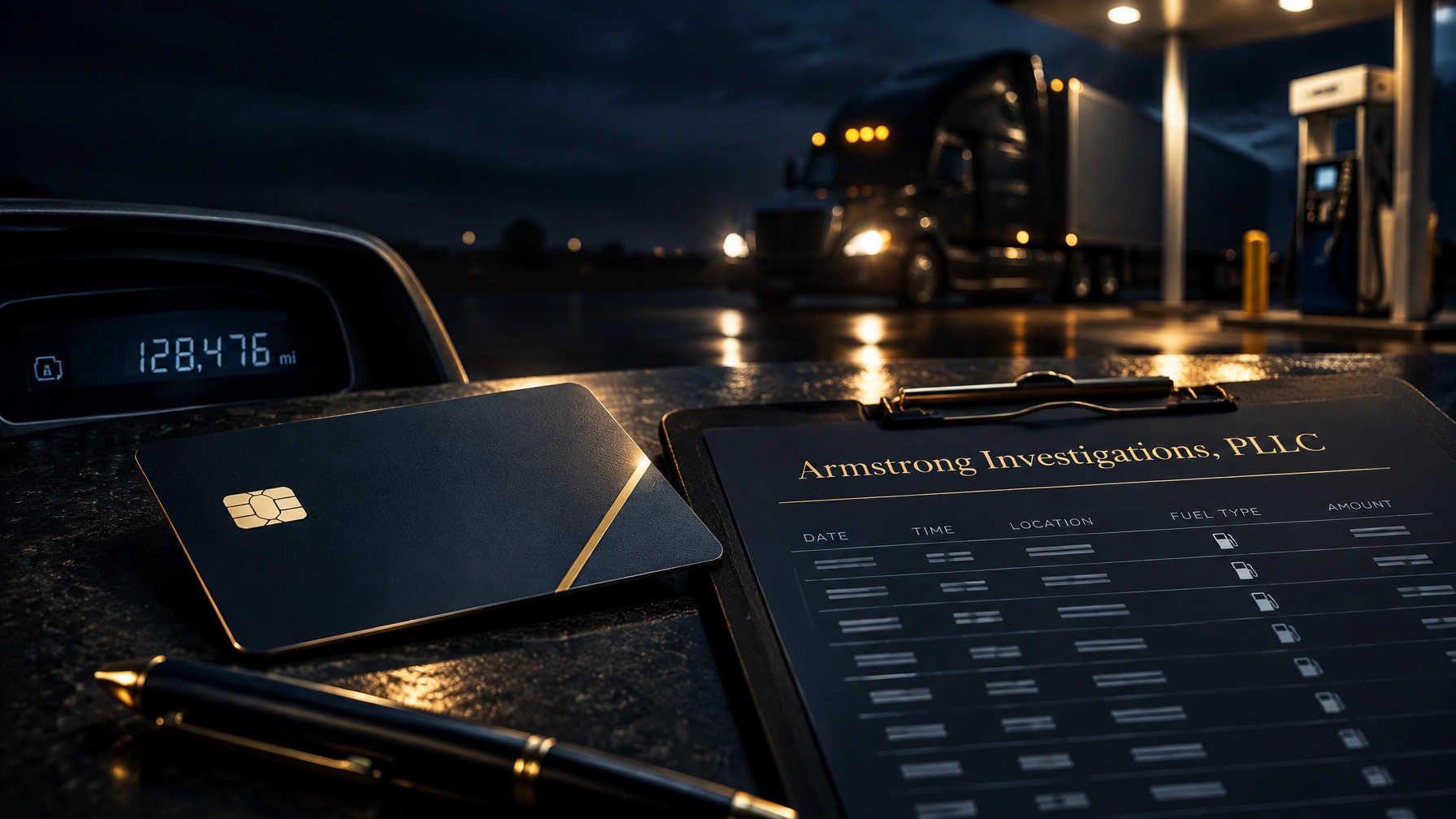
For Texas fleets, fuel loss can involve both internal misuse and external fraud. The issue is not limited to cargo theft, job-site theft, or general employee misconduct. Fuel-card fraud has its own evidence trail involving transaction timestamps, gallons, fuel type, odometer entries, telematics, route history, tank capacity, station locations, and vendor records.
Armstrong Investigations, PLLC helps businesses, counsel, insurers, and fleet managers organize those facts into a clear investigative record. Our role is fact-finding: identifying inconsistencies, documenting relevant information, and presenting findings in a way that management and retained professionals can evaluate.
Why fleet fuel fraud can remain hidden
Fuel fraud often survives because each individual transaction appears ordinary.
A card is used at an approved station. The driver enters a valid personal identification number. The fuel type appears compatible with the vehicle. The receipt is uploaded. The expense is coded as routine fleet maintenance.
The problem becomes visible only when the data is compared across systems.
Examples include:
- A vehicle is recorded as fueling in Dallas while telematics place it in Tarrant County.
- The odometer increases by only a few miles between unusually large fuel purchases.
- A gasoline vehicle is repeatedly associated with diesel transactions.
- A card is used after the driver’s shift or while the assigned vehicle is parked at a company yard.
- Multiple cards appear at the same fueling location within minutes.
- Fuel purchases exceed the practical capacity of the assigned tank.
- A driver’s reported route does not explain the location or timing of the transaction.
- A vendor’s invoices do not match card-system records or fleet fuel deliveries.
- Fuel inventory falls faster than the company’s documented usage would suggest.
None of these indicators proves wrongdoing by itself. Each is a reason to examine the underlying records and preserve the context before making an accusation.
Common Texas fleet fuel-loss patterns
Unauthorized fuel-card use
A fuel card may be assigned to a vehicle, driver, department, or cost center. If controls are weak, the card can be used for personal vehicles, family vehicles, another employee’s vehicle, or a portable container.
Card sharing is especially difficult to identify when employees know the same PIN or when cards are kept in a common vehicle. A transaction may be attributed to the assigned driver even though another person completed it.
The first question is not simply, “Who had the card?” It is:
Was the assigned vehicle, driver, and business activity consistent with the transaction at that exact time?
That question requires comparisons among card records, dispatch logs, timekeeping, vehicle location, route history, and work orders.
Odometer and mileage misreporting
Many fuel systems rely on the user to enter an odometer reading. That information can be useful, but it is not always independently verified.
Investigators and fleet managers may look for:
- Decreasing odometer readings.
- Repeated identical readings.
- Unusual jumps between entries.
- Fuel purchases with little corresponding mileage.
- Odometer values that conflict with maintenance records.
- Multiple vehicles associated with the same mileage sequence.
- Fuel economy that changes sharply without a mechanical explanation.
Mileage anomalies should be reviewed carefully. A vehicle may idle for long periods, operate in heavy traffic, tow equipment, or experience a mechanical issue. The purpose of the review is to identify a pattern that warrants explanation, not to treat a single irregular entry as conclusive proof.
After-hours fueling at unapproved locations
A late-night transaction is not automatically improper. Fleets may operate around the clock, respond to emergencies, or travel outside normal business hours.
The concern arises when after-hours fueling is combined with other facts, such as:
- No corresponding route or dispatch assignment.
- A fueling location outside the approved service area.
- A vehicle that was documented as inactive.
- A second transaction shortly before or after the first.
- A purchase made while the assigned driver was not working.
- Fueling at a location with no business relationship to the company.
Companies should establish written rules for approved stations, geographic limits, emergency exceptions, and documentation. Without clear standards, management may have difficulty separating a policy violation from intentional diversion.
Card skimming and cloned credentials
Not every suspicious fuel transaction is caused by an employee. A fleet card may be compromised at a fuel pump or through another payment-system exposure. A cloned credential can then be used at locations the company has never approved.
Warning signs may include:
- Transactions in distant locations within an impossible travel window.
- Multiple purchases inconsistent with the vehicle’s fuel capacity.
- Activity after a card was physically secured.
- Purchases involving a fuel type the fleet does not use.
- A sudden increase in transactions at unfamiliar stations.
- Activity affecting multiple cards from the same fleet.
Texas agencies have reported concerns involving fuel theft, skimming, and pump-related manipulation. Fleet operators should consider reporting suspected payment compromise to the card issuer and appropriate public authorities. The Texas Department of Licensing and Regulation provides information about motor-fuel metering, fuel quality, and suspected skimmer reporting through its Motor Fuel Metering and Quality resources. The Texas Comptroller also maintains information concerning motor-fuel investigations.
A private investigator does not replace the card issuer’s fraud team or a regulatory investigation. An independent corporate investigation can help organize the company’s records, identify the affected transactions, and preserve a timeline for counsel, insurers, and management.
Bulk fuel theft and inventory loss
Fuel-card fraud and bulk fuel theft may overlap, but they are not the same problem.
Bulk fuel can be diverted from:
- Above-ground storage tanks.
- Transfer vehicles.
- Job or service yards.
- Fleet trucks with large tanks.
- Fuel-delivery areas.
- Portable tanks or auxiliary containers.
A company may notice the loss through inventory reconciliation rather than a card statement. For example, the recorded fuel delivered to a yard may exceed the amount reflected in vehicle usage, or the tank level may fall during periods when fleet activity was limited.
A thorough review may compare:
- Delivery tickets.
- Tank gauge readings.
- Dispensing logs.
- Vehicle fuel records.
- Telematics-estimated usage.
- Maintenance and repair records.
- Access logs and camera footage maintained by the business.
- Vendor invoices and adjustment records.
The investigation should not assume that every inventory discrepancy is theft. Meter calibration, evaporation, data-entry errors, leaks, maintenance activity, and unrecorded emergency use may also affect the numbers.

How telematics and fuel-management reports reveal discrepancies
The strongest fuel-fraud reviews usually combine several sources rather than relying on one report.
Fuel-card data
Request transaction-level data rather than only monthly totals. Useful fields may include:
- Card or account identifier.
- Assigned vehicle and driver.
- Date and time.
- Station location.
- Fuel type.
- Gallons.
- Price.
- Odometer entry.
- Authorization result.
- Declined transactions.
- Manual adjustments.
- Receipt images, where available.
The goal is to analyze patterns by vehicle, driver, station, time window, and geography.
Telematics and GPS data
Telematics can help determine whether the assigned vehicle was near the reported fueling location. Depending on the system and retention period, records may show:
- Vehicle location.
- Ignition status.
- Travel direction.
- Engine hours.
- Route history.
- Idle time.
- Geofenced yard activity.
- Tank-level estimates.
A GPS mismatch is an investigative lead, not automatic proof. Location accuracy, device outages, cellular gaps, and vehicle reassignment should be considered before drawing conclusions.
Tank capacity and fuel-consumption analysis
Compare gallons purchased with known tank capacity and recent fuel levels. Repeated purchases near or above practical capacity may indicate a data error, multiple fueling events, fuel transfer to another container, or a problem with the transaction record.
Fuel economy should also be reviewed over a reasonable period. A sudden change may reflect heavy loads, weather, traffic, idling, maintenance issues, or route changes. A persistent unexplained deviation is more significant than a single unusual result.
Vendor and station records
Where appropriate and legally available, management may request supporting records from the station or fuel vendor. These can include invoices, transaction logs, delivery records, account notes, and records of disputed charges.
Vendor collusion is a sensitive possibility. It should not be alleged based solely on a driver’s frequent use of one location. More meaningful indicators may include repeated transactions that lack corresponding fuel usage, unusual manual adjustments, inconsistent receipts, identical patterns across multiple cards, or communications suggesting coordinated conduct.

Documenting a suspected fuel-fraud matter without tipping off suspects
Early handling can affect the quality of the investigation. If a company immediately confronts a suspected employee or vendor, relevant records may be deleted, explanations may become coordinated, or routine access may change.
Management and counsel should consider a controlled, documented approach that may include:
- Preserve existing records. Export fuel-card data, telematics records, dispatch information, time records, invoices, and relevant communications according to company policy.
- Define the review period. A short sample may miss a recurring pattern. The appropriate period depends on the suspected conduct, data retention, and business circumstances.
- Limit unnecessary disclosure. Share the concern with personnel who need to know and coordinate with counsel when appropriate.
- Maintain an evidence log. Record what was collected, when it was collected, by whom, and from which system.
- Separate facts from assumptions. Identify the transaction, the conflict, the possible explanations, and the next verification step.
- Preserve original files. Work from copies for analysis and retain source exports in a controlled location.
- Use lawful investigative methods. Any professional surveillance, interviews, records review, or field activity should be authorized and conducted within applicable law and company policy.
- Avoid premature accusations. A neutral fact-finding process improves the reliability of interviews and reduces the risk of confusing an error with intentional conduct.
Armstrong Investigations, PLLC can help create a chronology, organize anomalies, conduct appropriate field fact-finding, and prepare a clear investigative report. The report may be useful to management, insurers, and retained legal professionals, but it does not provide legal advice or determine legal liability.
A practical response plan for fleet managers
When a fuel discrepancy appears, fleet leadership should consider the following sequence:
Stabilize the account
Depending on the circumstances, the company may temporarily suspend an affected card, reset credentials, review shared PINs, or move to a replacement card. Those steps should be coordinated so that they do not destroy data or unnecessarily alert individuals before the preservation plan is complete.
Identify the scope
Review whether the issue involves one card, one vehicle, one station, one driver, a vendor account, or several related transactions. Patterns across multiple vehicles may suggest a system or external compromise rather than a single-user issue.
Compare independent records
Do not rely only on an employee explanation or a card-system note. Compare the transaction with telematics, dispatch, timekeeping, odometer history, tank levels, maintenance activity, and business purpose.
Review control weaknesses
Ask how the transaction passed through the company’s controls:
- Was the card assigned to a specific vehicle?
- Were unique PINs used?
- Was the station approved?
- Did the system require an odometer entry?
- Was the vehicle location checked?
- Were exceptions reviewed?
- Were cards regularly reconciled?
- Could a driver fuel another vehicle without detection?
This review helps management address the process problem while the individual transaction is being examined.
Prepare a neutral report
A useful report generally includes:
- Scope and assignment.
- Records reviewed.
- Methodology.
- Chronology.
- Transaction exceptions.
- Corroborating or contradictory evidence.
- Interview summaries, if authorized.
- Images or documents supporting material findings.
- Limitations and unresolved questions.
- Recommended next investigative steps.
DFW and North Texas fleet investigations
Fleet operators throughout the Dallas-Fort Worth Metroplex may have vehicles crossing several jurisdictions in a single day. A route may begin in Dallas, pass through Tarrant or Denton County, and end in Collin, Rockwall, Ellis, Kaufman, or Johnson County.
That regional footprint can make a fuel review more complicated when:
- Fueling locations fall outside the dispatch area.
- Vehicles are reassigned between branches.
- Multiple yards use similar card-account structures.
- Vendors serve both commercial and personal customers.
- Telematics and fuel systems use different time zones or reporting formats.
- Records are maintained by separate departments.
A DFW private investigator should understand the difference between a transaction anomaly and a completed finding. Armstrong Investigations, PLLC provides corporate investigations and Texas private investigations for businesses that need organized, defensible fact-finding in Dallas, Fort Worth, and throughout North Texas.
Frequently asked questions
What is a phantom fill-up?
A phantom fill-up is a fuel transaction that appears in company records but does not correspond to legitimate fuel entering the assigned vehicle for business use. It may involve a different vehicle, a portable container, a false transaction, duplicated records, or a transaction connected to a compromised card. The term describes a suspected discrepancy, not a conclusion about who caused it.
Can telematics prove that a fuel card was misused?
Telematics can help establish whether a vehicle was near a fueling location and whether the timing is consistent with the transaction. It may also help compare fuel purchases with route, tank-level, and mileage information. Telematics alone may not establish who used a card or why a discrepancy occurred, so it should be combined with other records.
Should a company confront the driver immediately?
An immediate confrontation may be appropriate in some urgent situations, but it can also affect evidence preservation and future interviews. Management should consider consulting counsel and establishing a controlled fact-finding plan before taking steps that could alert a suspect or vendor.
What does a private investigator cost for a fuel-fraud investigation?
Private investigator cost depends on the scope, number of vehicles and transactions, data availability, geographic area, interviews, field work, and reporting requirements. A focused transaction review may require fewer resources than a multi-location investigation involving drivers, vendors, bulk fuel inventory, and professional surveillance. Armstrong Investigations, PLLC can discuss the objectives and information available before recommending an investigative approach.
Can Armstrong Investigations, PLLC investigate a fuel vendor?
We can conduct authorized fact-finding involving vendor records, transaction patterns, interviews, publicly available information, and other lawful investigative methods. A vendor-focused review may also include background checks or corporate due diligence when management is evaluating a continuing relationship.
Does Armstrong Investigations, PLLC provide legal advice?
No. Armstrong Investigations, PLLC provides investigative and fact-finding services. Findings may be organized for management, insurance professionals, and retained counsel, who can evaluate the legal and business implications.
Protect your fleet records before a small discrepancy becomes a larger loss
Fuel fraud often becomes expensive because the first irregular transaction is treated as an isolated mistake. A structured review can show whether the issue is a data-entry error, weak internal control, compromised card, vehicle problem, inventory loss, or a broader pattern requiring additional investigation.
If your fleet operates in Dallas, Fort Worth, or the surrounding DFW counties, contact Armstrong Investigations, PLLC at 214-851-3800. We can discuss corporate investigations, fleet fuel-loss concerns, legal investigative services, and a practical plan for documenting the facts without making unsupported assumptions.
For related services, see:
- Corporate Investigations and Background Checks
- Corporate Due Diligence and Risk Mitigation
- A Tech-Forward Approach to Surveillance
- Private Investigator Cost in Dallas, Texas
- Strategic Intelligence for Legal Professionals
Jasen A. Armstrong, J.D.
Armstrong Investigations, PLLC
P: 214-851-3800 | W: armstronginvestigations.com
Texas DPS Lic. #: 166353101 | Affiliated with TCS Consulting (TX DPS Lic. #: C20493)