

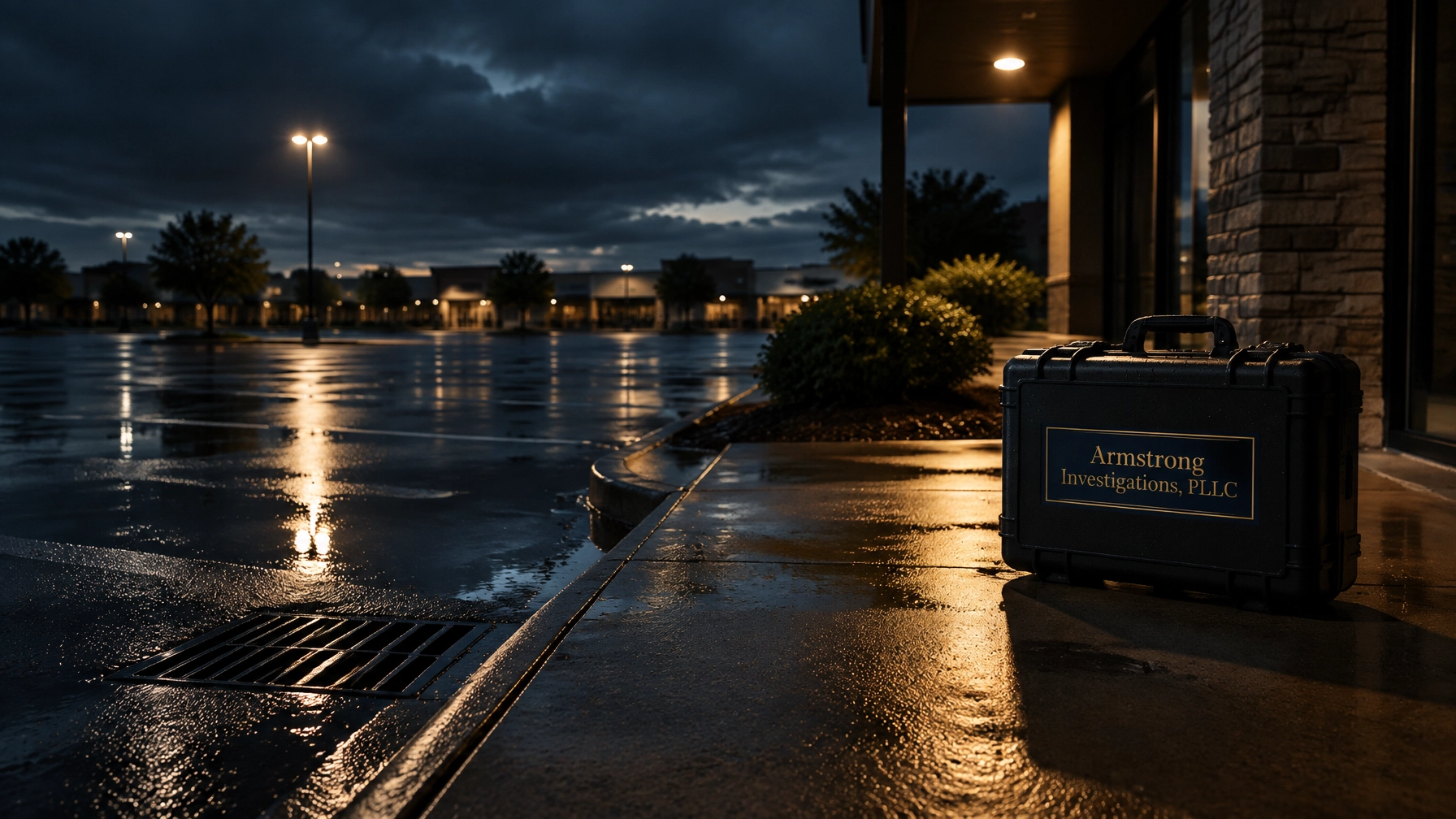
A slip, trip, or fall can take only a few seconds. The physical conditions surrounding that incident may look completely different a few hours later.
A wet surface can dry. Standing water can drain. A damaged curb can be patched. A temporary warning sign can appear, or disappear. A burned-out light can be replaced. Parked vehicles can change sight lines, and surveillance footage may be overwritten through routine system practices.
For counsel, insurers, property managers, and businesses evaluating what happened, early documentation can provide an objective record of the scene as it existed near the time of the incident. That record does not determine fault. It preserves factual information that can later be reviewed alongside witness accounts, medical records, maintenance documents, video, and other evidence.
At Armstrong Investigations, PLLC, our DFW private investigator services can help document premises conditions in Dallas, Fort Worth, and throughout North Texas. A careful scene review may be appropriate after an incident at a shopping center, apartment community, office property, hotel, warehouse, school, medical facility, or parking garage.
Why the first documentation matters
Premises conditions are often temporary or variable. A parking lot may be wet after a storm but dry by the time someone returns to photograph it. A walkway may be obstructed by delivery equipment in the morning and clear in the afternoon. A vehicle parked beside a curb may block a view that was open, or create a blind area that did not exist earlier.
The first documentation should focus on what can be observed and measured, not on reaching a conclusion about responsibility.
A useful early scene record may include:
- The exact location of the reported incident
- The surface condition
- Lighting and shadows
- Drainage, pooling, or runoff
- The approach path and available sight lines
- Signs, cones, painted markings, and other warnings
- Camera locations and likely coverage
- Weather and general environmental conditions
- Nearby businesses, entrances, sidewalks, ramps, curbs, and drive lanes
- Photographs and video from wide, medium, and close perspectives
This approach is different from taking only one close-up photograph of a crack, puddle, or uneven surface. Context matters. A fact finder may need to understand how the condition related to the walking route, the surrounding property, and the person’s likely line of sight.

Photograph the scene from more than one perspective
A strong scene documentation package generally begins with photographs that show the overall setting before moving closer to the specific condition.
Wide-area photographs
Wide photographs can show:
- The building or property entrance
- The parking row or garage level
- Pedestrian paths
- Drive lanes and crosswalks
- Nearby ramps, stairs, curbs, and sidewalks
- Lighting fixtures and poles
- Landscaping, signs, posts, walls, and other obstructions
- The relationship between the reported incident location and nearby entrances
These images help establish where the condition was located and how a person would typically approach it.
Mid-range photographs
Mid-range photographs connect the overall scene to the condition itself. They may show the hazard in relation to:
- A curb or ramp
- A marked pedestrian route
- A storefront entrance
- A pay station or garage elevator
- A loading area
- A drainage feature
- A light fixture
- A warning sign or painted marking
Close-up photographs
Close-up images can document the surface, defect, residue, water, debris, patchwork, uneven transition, or other physical feature. A scale reference may help show dimensions, but the method used should be recorded clearly.
Photographs should retain original metadata whenever possible. The investigator should document when the images were captured, where they were captured, and whether the scene was altered before documentation began.
Lighting and sight lines are part of the scene
Lighting is not just a background detail. It can affect what is visible from a walking path and how a surface appears in a photograph.
A scene review may document:
- Whether the incident occurred during daylight, dusk, nighttime, or artificial lighting
- The location and orientation of light fixtures
- Whether fixtures were illuminated during the inspection
- Areas of shadow or sharp contrast
- Landscaping, vehicles, walls, or signs that blocked illumination
- Whether the surface blended into the surrounding pavement
- The direction from which a person would likely approach
- Whether the condition was visible from that approach
A DFW private investigator may also record measurements with appropriate tools, including the distance from the approach point to the condition, the distance to a light fixture, and the height or position of an obstruction. Depending on the assignment, a qualified professional may use a light meter or other equipment to document illumination levels.
The purpose is not to announce whether the lighting was legally sufficient. It is to preserve measurable and observable facts for counsel and insurers to evaluate.
Sight-line documentation is equally important. A photograph taken directly above a condition may make it appear obvious. A photograph taken from the actual approach path may show that a vehicle, landscaping, shadow, sign, or grade change affected visibility. Both perspectives may be relevant.
Surface, drainage, and weather conditions can change quickly
Water-related conditions are especially time-sensitive. In North Texas, heavy rain can create temporary pooling in a parking lot, while heat and wind may change the appearance of the surface soon afterward.
Documentation may include:
- Standing water and its approximate location
- Drain covers, trench drains, gutters, and downspouts
- Leaves, dirt, trash, or other material near a drain
- Low areas, depressions, or visible slopes
- Water runoff paths
- Wet, dry, oily, stained, or discolored pavement
- Cracks, broken concrete, raised edges, or uneven transitions
- Tire tracks, footprints, or disturbance patterns
- Weather conditions at the time of inspection
- Recent precipitation, if independently documented or reported
A visual record should not be treated as a substitute for specialized testing. If a matter requires friction testing, engineering analysis, surveying, or drainage evaluation, counsel may consider retaining an appropriate technical professional. A private investigator can help preserve the scene and collect factual observations without presenting those observations as an engineering or legal opinion.

Signs, cones, markings, and pedestrian routing
Warning devices and markings should be documented exactly as found.
That includes:
- Wet-floor or caution signs
- Cones, barricades, tape, or temporary barriers
- Painted arrows and crosswalks
- Accessible parking markings
- Curbs and painted curb areas
- Loading-zone or no-parking markings
- Directional signs
- Construction or maintenance notices
- Signs that are blocked, turned away, damaged, or difficult to read
The position of a warning device can matter as much as its presence. A cone beside a condition may be visible from one angle but hidden by a vehicle from another. A sign may be several feet away from the reported location or positioned outside the normal walking path.
Documentation should capture the sign or marking in context and, when appropriate, from the direction a person would have approached. It should also note whether the sign appears permanent or temporary, without assuming when it was placed.
Camera coverage and retention should be addressed quickly
Surveillance footage can be valuable in a premises investigation, but camera systems vary widely. Some cameras cover entrances or drive lanes without capturing the sidewalk directly. Others may have blind spots caused by columns, landscaping, roof overhangs, parked vehicles, or changing lighting.
During a scene review, an investigator may document:
- Visible camera locations
- The direction each camera appears to face
- Cameras mounted on buildings, poles, garages, or adjacent structures
- Whether the area is covered by fixed or moving cameras
- Entrances, exits, drive lanes, and walkways that may be captured
- The property or security operator believed to control the system
- Any indication that cameras were inactive, obstructed, or under repair
Camera retention is not uniform. Storage periods, system settings, motion detection, overwrite cycles, and access procedures differ by property and vendor. For that reason, counsel may want to evaluate preservation requests promptly when video could exist.
An investigation should not assume that a visible camera recorded the incident or that footage remains available. Instead, the goal is to identify potential sources, document their location, and help counsel and insurers evaluate appropriate next steps.

Maintenance and inspection records may provide additional context
The physical scene is only one part of a premises review. Records may help establish how a property was inspected, maintained, repaired, or monitored over time.
Depending on the assignment, potentially relevant records may include:
- Parking-lot inspection checklists
- Sidewalk and walkway inspection logs
- Drain cleaning and repair records
- Landscaping and power-washing schedules
- Lighting inspection and replacement records
- Work orders and repair invoices
- Prior incident reports
- Customer or tenant complaints
- Property management agreements
- Vendor contracts
- Written inspection or hazard-response procedures
- Camera maintenance records
These records may be held by a property owner, tenant, management company, maintenance contractor, security vendor, or corporate office. Armstrong Investigations, PLLC can assist with factual investigative tasks and records-related inquiries as directed by the client or counsel. Formal legal requests, subpoenas, and litigation strategy remain matters for the client’s legal team.
The objective is not to select isolated documents that support one side. A professional investigation should seek an accurate record, including information that may clarify, limit, or complicate the initial account.
When accident reconstruction may be appropriate
Not every slip-and-fall requires accident reconstruction. In some matters, however, a technical review may help organize measurements, photographs, video, witness statements, and environmental conditions.
Accident reconstruction may be considered when questions involve:
- The path taken before the reported fall
- The relationship between a person and a surface condition
- Visibility from a specific approach
- Vehicle or pedestrian movement in a parking area
- Lighting and shadows
- The timing of water accumulation or cleanup
- The location of cameras and potential video angles
- Conflicting accounts about where or how an event occurred
A private investigator’s field documentation may provide foundational material for counsel, an insurer, or a qualified reconstruction professional. The documentation itself should distinguish between direct observations, measurements, statements from others, and later analysis.
That distinction protects the integrity of the work. A photograph shows what was visible at a particular time. A witness statement reflects what that person reported. A technical opinion is a separate evaluation that should come from an appropriately qualified professional.

DFW locations and conditions vary
A scene in downtown Dallas may involve a structured parking garage, concrete ramps, elevator approaches, and controlled lighting. A retail center in Fort Worth may involve broad drive lanes, landscaped islands, pedestrian crossings, and multiple businesses sharing a lot.
Conditions can also vary across:
- Collin County retail and office developments
- Denton County apartment and commercial properties
- Rockwall County shopping centers
- Ellis County industrial and retail locations
- Kaufman County roadway-adjacent businesses
- Johnson County commercial properties
- Dallas and Tarrant County garages, sidewalks, and mixed-use developments
A scene documentation plan should fit the property. The relevant camera, drainage, lighting, and pedestrian issues at an apartment complex may differ from those at a warehouse, medical campus, hotel, or grocery-anchored shopping center.
What to provide when requesting an investigation
When contacting a DFW private investigator, useful initial information may include:
- The property name and complete location
- Date and approximate time of the incident
- Exact area involved, such as entrance, row, garage level, or sidewalk
- Whether the condition remains visible
- Whether repairs or cleanup have occurred
- Names of known witnesses or responding personnel
- Whether an incident report was created
- Whether cameras may cover the area
- Any photographs, video, notices, or correspondence already available
- Whether counsel or an insurer has provided specific documentation instructions
The private investigator cost for a scene documentation assignment can depend on travel, urgency, location size, equipment, after-hours access, records work, surveillance needs, and the level of reporting requested. A clear scope helps avoid unnecessary work and gives the client a better basis for evaluating the assignment.
A practical “before the scene changes” checklist
When safe and appropriate, early documentation should consider:
- Photograph the entire area before focusing on the specific condition.
- Record the date, time, weather, and lighting conditions.
- Capture the approach path and realistic sight lines.
- Document surface texture, water, debris, cracks, slopes, and drainage features.
- Photograph signs, cones, markings, and barriers in context.
- Identify visible cameras and likely coverage areas.
- Note nearby vehicles, landscaping, walls, posts, and other obstructions.
- Preserve original photographs and videos with reliable file information.
- Record who was present and what each person directly reported.
- Promptly identify potential maintenance, inspection, incident, and video records.
Do not alter, clean, repair, move, or test a condition without appropriate authorization and safety precautions. Scene documentation should be conducted lawfully, respectfully, and without interfering with property operations or emergency response.
Get the scene documented while the facts are still visible
Whether the matter involves a sidewalk defect in Dallas, poor visibility in a Fort Worth parking garage, drainage concerns in Collin County, or a commercial-property incident in Denton, Rockwall, Ellis, Kaufman, Johnson, or Tarrant County, early documentation can preserve details that may otherwise disappear.
Armstrong Investigations, PLLC provides Texas private investigations and legal investigative services for counsel, insurers, businesses, and private clients. Our work may include scene documentation, professional surveillance, photographic evidence collection, camera-location mapping, witness follow-up, and factual investigative reporting.
Call 214-851-3800 to discuss a DFW premises documentation assignment. We can help define the scope, identify time-sensitive evidence, and create a factual record for counsel and insurers to evaluate.
Suggested internal links
- Our Services, link the phrase “investigative services” or “scene documentation.”
- Strategic Intelligence for Legal Professionals, link the phrase “support for counsel.”
- A Tech-Forward Approach to Surveillance, link the phrase “professional surveillance.”
- Private Investigator Cost in Dallas, Texas, link the phrase “private investigator cost.”
- Corporate Investigations and Background Checks, link the phrase “business investigative support.”
Frequently asked questions
Why is early scene documentation important after a slip-and-fall?
Conditions can change through weather, cleaning, repairs, traffic, lighting changes, landscaping, and routine property operations. Early documentation preserves observations from a specific time instead of relying only on later recollections.
Can a private investigator determine who was at fault?
A private investigator should document facts, measurements, photographs, video sources, and witness accounts. Those materials may help counsel and insurers evaluate the matter, but the investigation should not declare fault or provide legal conclusions.
What should be documented in a parking-lot incident?
The documentation may include the surface, drainage, lighting, sight lines, signs, markings, cameras, surrounding layout, weather, nearby obstructions, witnesses, and any changes made after the reported incident.
How long do parking-lot cameras retain footage?
There is no single retention period for every property or system. Retention depends on system configuration, storage capacity, motion settings, operator practices, and other factors. Potential footage should be identified and addressed promptly.
Does every premises incident require accident reconstruction?
No. The need depends on the facts and the questions presented. Accident reconstruction may be useful when the matter involves disputed paths, visibility, timing, lighting, vehicle movement, measurements, or video angles.
What affects private investigator cost for scene documentation?
Cost can vary based on urgency, travel, property size, after-hours access, equipment, records work, surveillance requirements, reporting, and the scope requested by the client or counsel.
Jasen A. Armstrong, J.D.
Armstrong Investigations, PLLC
P: 214-851-3800 | W: armstronginvestigations.com
Texas DPS Lic. #: 166353101 | Affiliated with TCS Consulting (TX DPS Lic. #: C20493) & Howard Law, PLLC