



The Dallas-Fort Worth Metroplex has no shortage of private investigators. You’ll find former law enforcement officers running one-person shops out of North Richland Hills, large multi-state agencies with slick websites and rotating staff, and everything in between.
Choosing among them isn’t really about finding the cheapest option or the most decorated résumé. It’s about matching the investigator’s specific capabilities to what your case actually requires — and understanding that not all investigative work is equally useful once it enters a courtroom, a custody hearing, or a negotiation.
Here’s a practical framework for making that decision.
Start With the Non-Negotiables
Before comparing capabilities, every investigative firm you consider should clear a basic threshold. Any firm that doesn’t meet these criteria shouldn’t make your shortlist, regardless of price or marketing:
Texas DPS Licensing: Private investigators in Texas must hold a valid license issued through the Department of Public Safety. Verify the license number directly on the DPS database — not just on the firm’s website.
Local familiarity: A firm headquartered in Houston or Austin that covers DFW as part of a statewide territory isn’t the same as an operation with genuine roots in the Metroplex. Local knowledge — the streets, the neighborhoods, the county courthouse systems — matters for fieldwork efficiency and record access.
Reporting standards: Evidence is only useful if it’s documented correctly. Ask how reports are structured, how footage is preserved, and what the chain-of-custody process looks like. Vague answers to these questions are a meaningful signal.
Understanding the Three Investigator Profiles
Most DFW investigators fall into one of three categories. Each brings a different orientation to case work — and serves different needs better.
The Generalist
A generalist firm handles a broad range of case types: background checks one week, skip tracing the next, domestic surveillance the week after that. Versatility has value in certain contexts. What it typically lacks is the depth that complex cases require.
For a straightforward locate or a basic background verification, a competent generalist may be sufficient. For a contested custody matter, a high-net-worth divorce, or a case that will end up in front of a judge, the generalist’s breadth can become a liability.
The Former Law Enforcement Investigator
Many DFW investigators come from law enforcement backgrounds — police departments, sheriff’s offices, federal agencies. That experience carries real strengths: situational awareness, surveillance discipline, and comfort with high-stakes fieldwork.
The limitation is contextual. Law enforcement operates under criminal procedure and constitutional standards that differ substantially from the civil and family law environments where most private clients need results. An investigator oriented toward “catching the bad guy” may not instinctively think about what a family court judge needs to see, or how a piece of evidence will be challenged during a deposition.
The Law-Trained (J.D.) Investigator
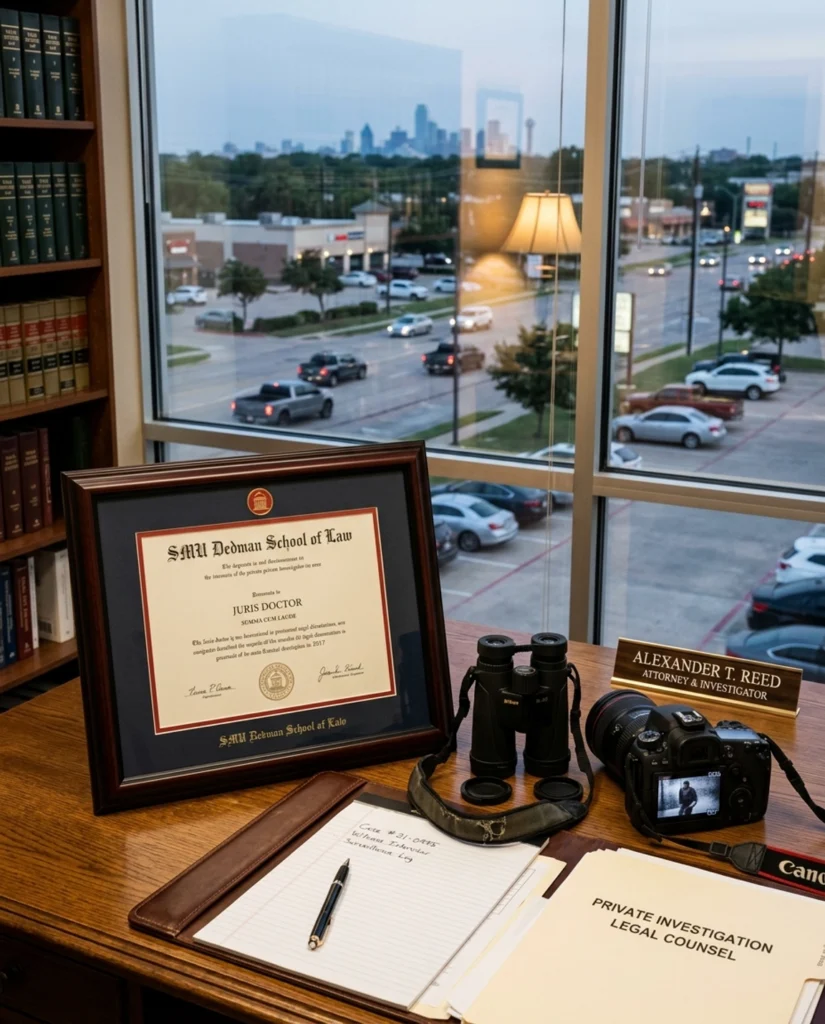
This is a distinct profile, and it’s the model Armstrong Investigations, PLLC was built around. When Jasen A. Armstrong’s J.D. education informs how investigations are planned and executed, the practical effect is that evidentiary thinking is embedded at the start — not retrofitted at the end.
Jasen A. Armstrong holds a Juris Doctor (J.D.) degree, is not licensed to practice law in Texas, and does not provide legal advice or legal representation. Armstrong Investigations, PLLC provides private investigation services only.
What does that mean in practice? It means we think about what a particular piece of evidence actually needs to establish, what it will face when challenged, and how it needs to be documented to survive that challenge. We’re not just gathering information — we’re building a file.
Specialization Matters More Than Generalism for High-Stakes Cases
When comparing DFW investigators, look specifically at whether they have documented experience in your case type. The three most common high-stakes categories in North Texas:
1. Pre-Divorce Investigations
The period before a divorce filing is filed is often the most strategically significant window of a domestic case. Evidence gathered before the proceeding becomes public — financial documentation, asset identification, lifestyle analysis — can shape how the entire process unfolds. An investigator who understands what that evidence needs to accomplish, and for whom, operates very differently than one who simply fills an assignment brief.
2. Spouse Surveillance
In Texas, fault grounds — including adultery — can be relevant to property division in certain cases. Documentation of conduct that establishes those grounds needs to be gathered discreetly, continuously, and in a format that will hold up. Gaps in surveillance footage, missed time stamps, or legally problematic observation methods can render otherwise compelling material unusable.
We work across the full Metroplex and surrounding counties — Rockwall, Ellis, Kaufman, Johnson — with the same operational standards regardless of geography.

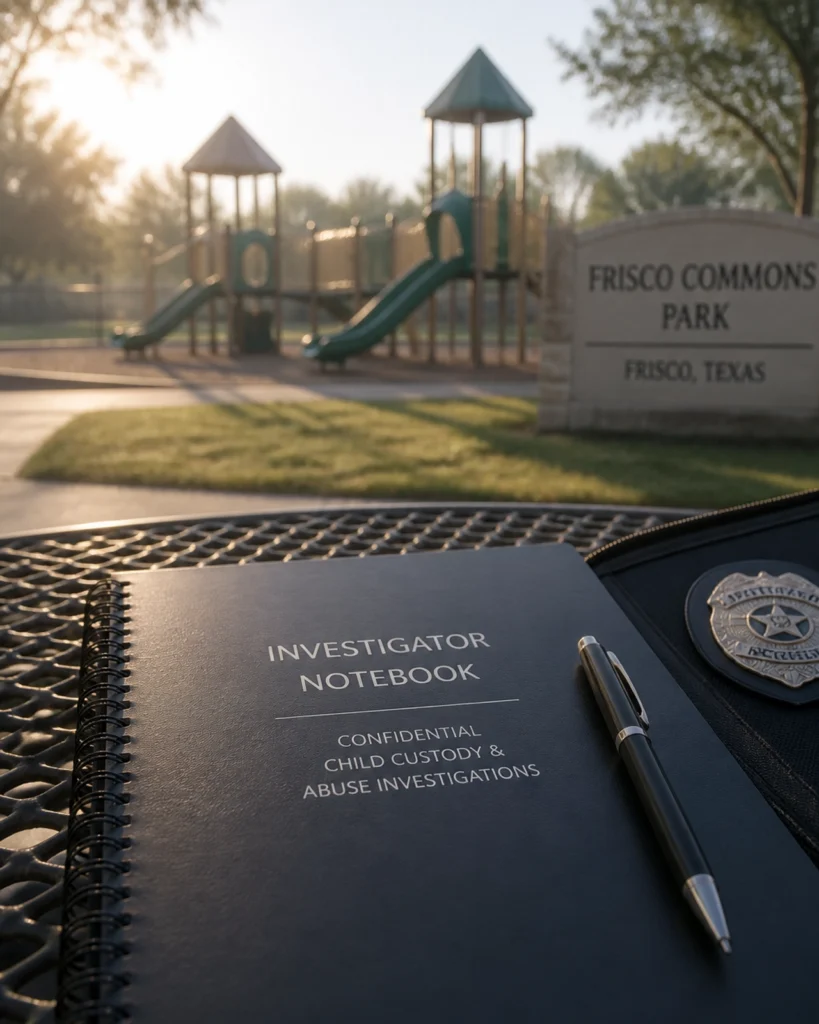
3. Child Custody and Parental Fitness
Cases involving a child’s safety or the fitness of a parent carry the highest emotional weight and among the most demanding evidentiary standards. Documentation must be objective, complete, and gathered in a way that protects rather than compromises the integrity of any resulting legal proceeding.
The Admissibility Question — Why It Decides Everything
The single most important question to ask any investigator you’re considering is not “How many cases have you handled?” It’s: “How do you ensure the evidence you gather is admissible?”
Evidence that was gathered improperly — in violation of Texas privacy statutes, through methods that breach the chain of custody, or in ways that conflict with applicable federal rules — is evidence that can be excluded. An excluded piece of evidence that you paid to obtain is worse than no evidence at all, because it gave the other side an opportunity to challenge your case’s integrity.
When we deliver a file to an attorney or a client, that file is built from the ground up to survive scrutiny. That standard isn’t an afterthought — it’s the organizing principle of how we work.
Coverage Across the DFW Metroplex
Armstrong Investigations, PLLC serves clients throughout the Metroplex and surrounding North Texas counties, including Dallas, Tarrant, Collin, Denton, Rockwall, Ellis, Johnson, Kaufman, Parker, Wise, Hunt, Navarro, Henderson, Hood, Somervell, Erath, and Palo Pinto. Fieldwork doesn’t stop at county lines — and neither does our coverage.
Three Questions to Ask Before You Hire
When you’ve narrowed your options, these questions will tell you what you need to know:
- Does the investigator understand the legal strategy the evidence needs to serve? Are they thinking about your case as a whole, or just the immediate assignment?
- Do they have specific, documented experience in your case type? General investigative experience and specific family law or corporate investigation experience are not interchangeable.
- What does their evidence documentation process look like? Ask specifically about chain of custody, reporting format, and how footage or records are preserved.
The right answer to all three reflects an operation that thinks about the end before it starts the work.
If you’re ready to discuss a specific situation, we’re glad to have a direct, confidential conversation about what an investigation can realistically accomplish for your case.

Armstrong Investigations, PLLC
214-851-3800 | armstronginvestigations.com
Texas DPS Lic. #: 166353101 | Affiliated with TCS Consulting (TX DPS Lic. #: C20493)