






When someone goes missing — a family member, a vulnerable adult, a witness critical to an upcoming trial — the hours immediately following matter more than almost anything else. What you do in that window, and who you involve, shapes what options remain open later.
At Armstrong Investigations, PLLC, missing persons cases are among the most time-sensitive work we handle. We serve clients across the Dallas-Fort Worth Metroplex and North Texas, and we’ve seen firsthand how the difference between a fast, focused response and a delayed one compounds with every passing day. If you’re considering bringing in a private investigator for a missing persons matter, here’s what you need to understand before making that call.
1. A Private Investigator Works Alongside Official Efforts — Not Instead of Them
The most common concern we hear from families is whether hiring a PI means giving up on law enforcement resources. It doesn’t. In fact, the two work best when they’re running in parallel.
Police departments and sheriff’s offices carry significant caseloads. An active missing persons case may receive initial attention and then cycle into a slower administrative track as urgency fades and other calls come in. A dedicated private investigator operates on your timeline, following leads that may not clear the threshold for immediate official action but are operationally significant to finding your person.
We don’t compete with law enforcement. We fill the gaps they can’t cover.
2. A Law-Trained Perspective Changes How Evidence Is Gathered
Not all investigative firms think about missing persons cases with a courtroom in mind. That’s a significant gap, because the outcomes of many missing persons investigations eventually involve legal proceedings — custody disputes, estate matters, civil claims, criminal proceedings.
At Armstrong Investigations, Jasen A. Armstrong holds a Juris Doctor (J.D.) degree and brings a law-trained perspective to how information is gathered and documented throughout an investigation.
Jasen A. Armstrong holds a Juris Doctor (J.D.) degree, is not licensed to practice law in Texas, and does not provide legal advice or legal representation. Armstrong Investigations, PLLC provides private investigation services only.
That framework shapes methodology. Evidence gathered correctly from the start is evidence that remains useful if the case evolves in a direction that requires it.

3. Skip Tracing Is More Sophisticated Than Most People Realize
Skip tracing — the process of locating a person who has left a known location and whose current whereabouts are unknown — is frequently the first operational step in a missing persons investigation. It’s also significantly more involved than a web search or a database lookup.
Professional skip tracing combines high-level commercial database access, proprietary tools, utility and address record research, and a structured methodology for cross-referencing partial information into a working location hypothesis. When a person has intentionally left — or has been moved — the trail still exists. Finding it requires the right tools and the experience to use them.
4. Digital Footprints Don’t Disappear Quickly
Social media activity, device location data, digital check-ins, and online behavior patterns leave trails that experienced investigators know how to read. Open-source intelligence (OSINT) techniques allow us to reconstruct a person’s movements and connections in the period leading up to and following a disappearance — often surfacing leads that physical canvassing alone would miss.
This isn’t surveillance in the traditional sense. It’s pattern analysis — and it frequently identifies the most productive direction for fieldwork to follow.

5. Surveillance Confirms What Skip Tracing Finds
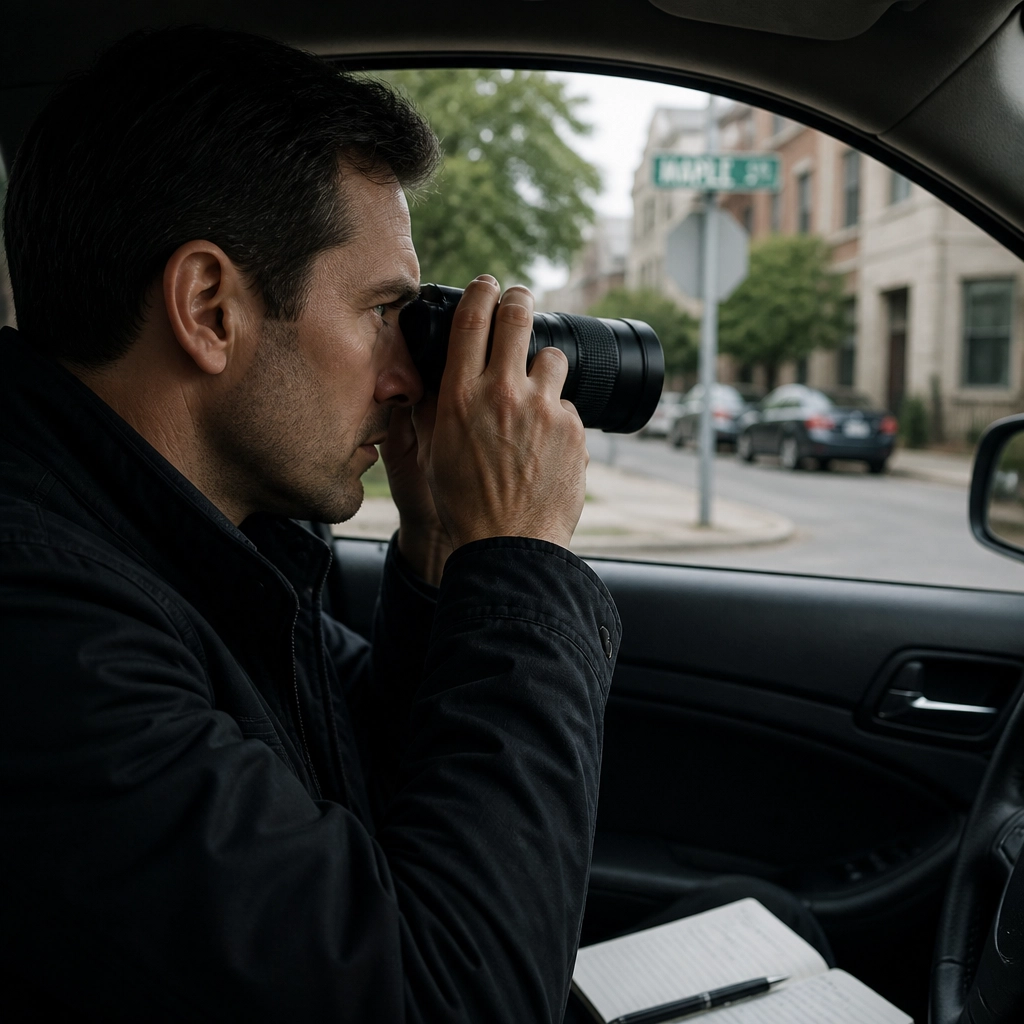
Once a probable location has been identified, physical surveillance confirms whether the person is actually there. A database hit or a social media post points to a location — surveillance determines whether that lead is current and whether the subject is present.
This two-stage approach — locate, then verify — is more reliable than either method in isolation and prevents the waste of resources on stale leads.
6. Proactive Fieldwork Often Makes the Difference
Some investigations move quickly because good data provides a clear lead. Others require ground-level work: canvassing the areas where the person was last seen, speaking with neighbors and contacts who weren’t interviewed by official responders, and pursuing information that doesn’t exist in any database.
We conduct this fieldwork actively and without waiting for leads to materialize on their own. In time-sensitive situations — runaways, at-risk individuals, witnesses needed before a legal deadline — a passive approach isn’t an option.
7. Welfare Checks Provide Families With Verified Answers
Not every missing persons engagement is a disappearance. Sometimes a family member has stopped returning calls, a vulnerable adult has cut off contact, or someone’s behavior has raised concerns without a clear crisis. In these situations, a professional welfare check provides something a phone call or a neighbor’s knock can’t: documented, objective confirmation of a person’s condition and circumstances.
We serve clients across all 17 North Texas counties in our coverage area, and welfare checks can be deployed quickly when a family needs answers rather than reassurance.
8. Discretion and Ethical Standards Are Non-Negotiable
Missing persons cases bring investigators into direct contact with some of the most sensitive information in people’s lives. The subject being sought, the family who hired us, and the network of contacts we interview all deserve to have that information handled carefully.
Armstrong Investigations operates under a strict standard of confidentiality. Our methods comply with Texas law, and we don’t take shortcuts that could compromise the integrity of the information we gather or the rights of anyone involved.
9. Understand the Scope and Cost Before the Search Begins
Missing persons investigations are labor-intensive, and the costs should be discussed openly before work begins. A professional firm will be direct about what’s realistic within a given budget and timeline — whether that means a focused skip-tracing engagement with a defined endpoint or a more sustained multi-phase investigation.
We don’t take on a case without having a clear conversation about what success looks like and what achieving it will require. Surprise billing in the middle of an already stressful situation is something we work specifically to avoid.
10. Professional Affiliations and Licensing Extend Your Investigator’s Reach
A properly licensed firm connected to a professional network can bring more resources to a missing persons case than a solo operator working in isolation. Armstrong Investigations, PLLC holds a Texas DPS license and works in affiliation with TCS Consulting, giving us access to technical capabilities — including digital forensics and advanced data analysis — that broaden what’s possible in complex cases.
When a case crosses county or state lines, that network matters.

Ready to Talk About Your Situation?
If someone you’re concerned about has gone missing in the DFW area or anywhere across North Texas — or if you’re an attorney dealing with a vanished witness or a person critical to pending proceedings — we are available to discuss the situation directly and confidentially.
Armstrong Investigations, PLLC serves Dallas, Tarrant, Collin, Denton, Rockwall, Ellis, Johnson, Kaufman, Parker, Wise, Hunt, Navarro, Henderson, Hood, Somervell, Erath, and Palo Pinto counties, and can coordinate resources beyond those boundaries when the case requires it.
Armstrong Investigations, PLLC
214-851-3800 | armstronginvestigations.com
Texas DPS Lic. #: 166353101 | Affiliated with TCS Consulting (TX DPS Lic. #: C20493)
Armstrong Investigations, PLLC provides private investigation services only. All investigative work is conducted for fact-finding and information-gathering purposes and does not constitute legal advice, legal counsel, or legal representation.