






One wrong hire at the executive level. One unvetted vendor with access to your server room. That’s often all it takes to turn a routine quarter into a litigation nightmare — and in a market as active as Dallas-Fort Worth, the volume of corporate transactions and hiring activity means the odds of exposure compound fast.
At Armstrong Investigations, PLLC, we work with businesses across the DFW Metroplex — from high-growth firms in Frisco and Plano to established operations in Downtown Dallas and Fort Worth’s cultural district. What we see consistently is this: most companies aren’t skipping background checks. They’re doing them wrong.
Here are the seven mistakes we encounter most often, and what it actually takes to fix them.
1. Trusting “Instant” Online Database Results
The appeal is obvious — fast, cheap, and it produces a PDF within minutes. The problem is that these services are aggregators pulling from public data sources that can be months or years out of date, and they routinely miss records from smaller county jurisdictions.
In the Dallas-Fort Worth region, this matters considerably. A case filed in Kaufman County or Palo Pinto won’t necessarily surface in a database that prioritizes major metro records. A “no record found” result from a $20 website is not clearance — it’s a gap in knowledge dressed up as one.
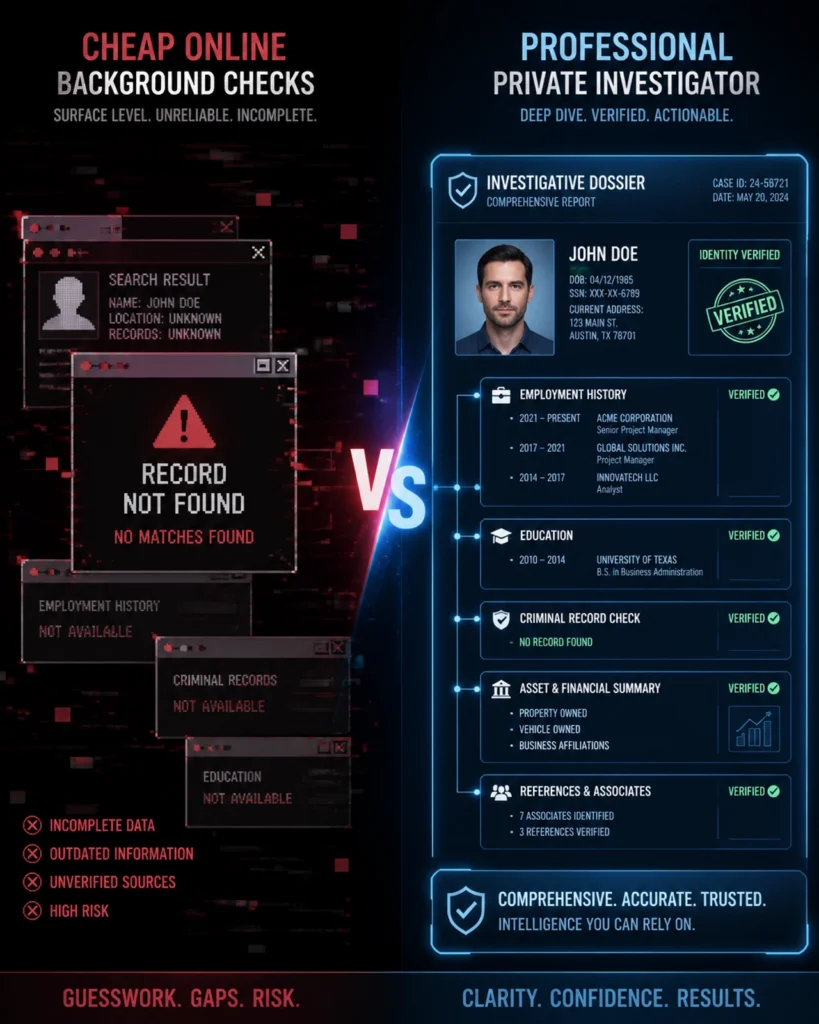
What to do instead: Primary source verification. That means checking directly with county courthouses and state repositories rather than relying on aggregated data. In a region that spans Dallas, Tarrant, Collin, Denton, Rockwall, Ellis, Johnson, Kaufman, Parker, Wise, Hunt, Navarro, Henderson, Hood, Somervell, Erath, and Palo Pinto counties, that verification process needs to be thorough and systematic.
2. Applying the Same Standard to Every Hire
A standard criminal and credit check makes sense for an entry-level position. Applied to a CFO or a Managing Director, it’s inadequate by a significant margin. Executives hold access — to finances, to systems, to institutional relationships — that makes their history worth examining at a depth that matches their authority.
Civil litigation records, regulatory actions (SEC, FINRA, and state-level equivalents), adverse media coverage, and professional reputation patterns are all relevant at the executive level and routinely absent from standard screening packages.

What to do instead: Executive vetting should function more like opposition research than routine screening — comprehensive, documented, and built around the specific risk profile of the role.
3. Ignoring the Vendor and Contractor Blind Spot
A company might have rigorous standards for direct employees while extending almost no scrutiny to the vendors and contractors who access their facilities, networks, or client data. That gap creates liability without any corresponding oversight.
If a third-party contractor’s employee commits a crime on your property or walks out with sensitive data, the reputational and legal consequences often land on your organization regardless of who technically employed that individual.

What to do instead: Build a vendor due diligence framework. Vet the principals of the companies you work with, assess their financial stability, and establish baseline expectations for their own internal screening processes. The weakest link in your vendor chain is the same as a weakness in your own operations.
4. Treating the Background Check as a One-Time Event
In Texas, employer liability isn’t limited to who you hire — it extends to who you keep. The legal distinction between negligent hiring and negligent retention is one that courts take seriously, and it matters for how companies manage employee records over time.
Negligent hiring addresses what you knew, or reasonably should have known, at the time of the employment decision. Negligent retention addresses what you learned afterward and chose not to act on. Under Texas H.B. 1188, certain protections exist for hiring individuals with criminal histories — but those protections narrow significantly when the prior conduct is directly related to the job’s responsibilities or involves serious financial or violent offenses.
What to do instead: Establish a policy for periodic review and ongoing monitoring for high-risk roles. When significant information surfaces about a current employee, a follow-up investigation isn’t optional — it’s how you demonstrate that your organization acted reasonably once it had reason to act.
5. Taking Credentials and Degrees at Face Value
Resume fraud is not a relic of a less sophisticated hiring era. It remains common across all professional levels, including among candidates with otherwise polished presentations. The gap between what a resume claims and what can be verified is frequently where the most consequential discrepancies live.
Degrees from unaccredited institutions, lapsed professional licenses, and credentials that appear current but carry disciplinary history are all patterns that surface regularly during thorough verification. For roles in finance, law, medicine, or any licensed profession, the regulatory implications of employing someone with compromised credentials extend to the company itself.
What to do instead: Verify directly with issuing institutions. For professional licenses, check state databases for active status and disciplinary flags — not just the certificate on the wall.
6. Leaving International History Unexamined
A domestic-only background check leaves a gap the size of any country where your candidate or vendor has lived or worked. Criminal records, civil judgments, regulatory sanctions, and international watchlist appearances aren’t captured by U.S.-focused searches.
For executives with substantial international careers, or vendors operating across borders, that gap isn’t a technical inconvenience — it’s a real and unexamined risk category.
What to do instead: If a subject has lived or worked outside the United States for any meaningful period, international searches should be a standard part of the vetting scope, not an optional add-on.
7. Gathering Information Without Thinking About How It Can Be Used
The final mistake is common among companies that do thorough research but do it in ways that create downstream problems. Information gathered through methods that violate the Fair Credit Reporting Act or applicable privacy statutes may be unusable when it matters most — and may expose the company to its own legal liability in the process.
A red flag found through an improper channel can’t be acted on cleanly. Worse, the candidate or subject may have grounds to pursue a claim based on how that information was gathered.

What to do instead: Work with a licensed investigative firm that understands the legal framework around information gathering. At Armstrong Investigations, PLLC, Jasen A. Armstrong holds a Juris Doctor (J.D.) degree and brings a law-trained perspective to every investigation. This means our methodology is designed to produce findings that are both accurate and usable — gathered correctly from the start.
The Bottom Line for DFW Businesses
The Dallas-Fort Worth corporate market is large, competitive, and legally active. The quality of your screening process determines the quality of your information — and ultimately, the quality of your decisions. Whether you are onboarding a new executive, vetting a strategic partner, or reviewing a vendor relationship, the standard should be set by what you need to know, not what’s easiest to obtain.
If your current background check process is built around speed and price rather than accuracy and completeness, we are glad to talk through what a more rigorous approach looks like for your organization.
Armstrong Investigations, PLLC
214-851-3800 | armstronginvestigations.com
Texas DPS Lic. #: 166353101 | Affiliated with TCS Consulting (TX DPS Lic. #: C20493)
Jasen A. Armstrong holds a Juris Doctor (J.D.) degree, is not licensed to practice law in Texas, and does not provide legal advice or legal representation. Armstrong Investigations, PLLC provides private investigation services only.