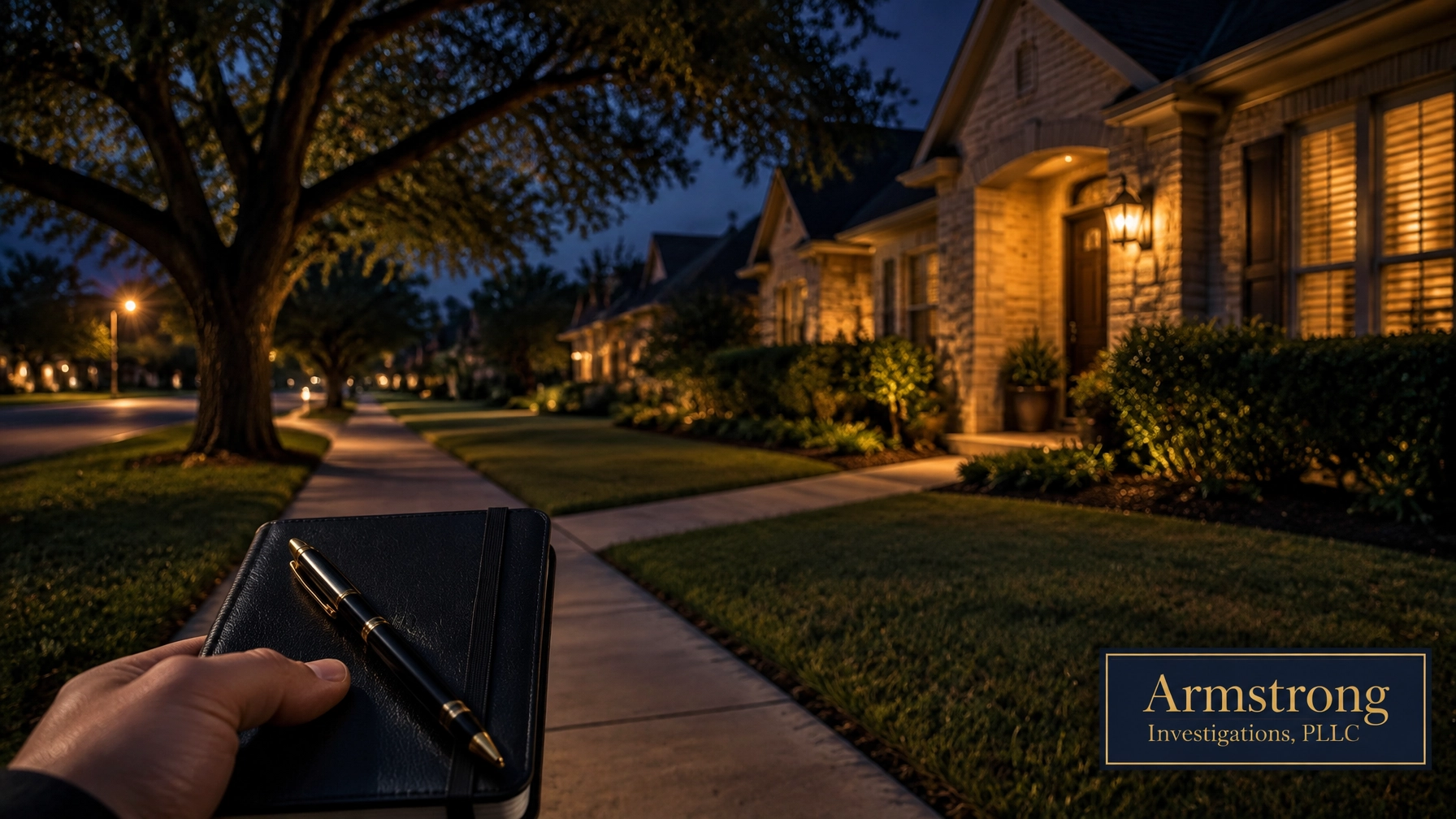
A car that circles the block more than once. A person who appears near your home on several evenings. A gate left open, a package disturbed, or a mark on a door that was not there the day before. A single observation may have an ordinary explanation, but a recurring pattern can understandably leave a homeowner wanting clearer facts.
After a suspicious incident, it helps to separate immediate safety from longer-term documentation. A private investigator may be able to observe and record relevant activity from a lawful vantage point, but an investigator cannot determine someone’s intent from appearances alone, guarantee that surveillance will capture an event, or replace emergency responders. The purpose of professional fact-finding is to document what can be observed, not to confront, threaten, or trespass.
This guide explains practical steps for homeowners in Dallas-Fort Worth and North Texas, and outlines what lawful investigative documentation may, and may not, establish. It is educational information, not legal advice or a home-security assessment.
Start with safety, not surveillance
If someone is trying to enter your home, threatening you, or creating an immediate risk of harm, call 911. Move to a safer place if you can do so without approaching the person. Do not go outside to confront or follow them, and do not delay contacting emergency services to collect a better photograph.
For activity that does not appear to involve an immediate emergency, contact the appropriate local law-enforcement agency through its non-emergency channel. Share what you observed, when and where it happened, and any available recording. If an incident may involve attempted entry, damage, theft, threats, or stalking, prompt reporting can help create a contemporaneous record. An investigator can document relevant observations for a client, but does not take the place of emergency services or law enforcement.
What a private investigator may be able to document
Texas regulates investigations companies and private-investigator work under Chapter 1702 of the Texas Occupations Code. Depending on the assignment and the facts, a properly licensed private investigator may be engaged to document recurring activity that is visible from a lawful location. The goal is to make a neutral record of observable events, not to turn suspicion into a conclusion.
For example, a private detective might document:
- The date, time, duration, and general location of an observed event.
- A person’s or vehicle’s observable description, including direction of travel.
- Whether a specific activity recurs, and how often it is observed during the assignment.
- Images or video of activity that can be captured lawfully from a public or authorized location.
- The investigator’s own observations in a time-organized report.
The difference between “a person walked past the house at 8:15 p.m.” and “a person was casing the house” matters. The first describes an observable event. The second asserts intent, which may not be established by the observation. A professional record should distinguish what was seen from what someone believes it means.
A DFW private investigator may also be asked to organize information the homeowner already has, such as a timeline, saved camera clips, photographs of damage, or a list of incident-report numbers. The value is often in assembling details consistently and identifying whether there is a repeatable pattern, not in claiming certainty about who is responsible.

The value, and limits, of surveillance
Surveillance can document activity during the time and place it is conducted. It may help answer a narrow question, such as whether a particular vehicle repeatedly stops on a public street near a property during specified hours. Professional surveillance can also provide context a homeowner’s camera may not capture, such as what happened immediately before or after an event visible in a short clip.
But surveillance is not continuous protection, and it cannot guarantee that an incident will happen while an investigator is present. A person may not return. Weather, traffic, lighting, obstructions, distance, and other practical conditions can affect what can be seen or recorded. A low-quality or partial image may not clearly identify a person or vehicle. Even clear footage may show activity without revealing a motive.
The investigator’s report should be understood within those limits: it describes the observations made, under the conditions and time period of the assignment. It is not a promise that every relevant fact will be discovered or that footage will establish identity, intent, or responsibility.
Search terms such as “private investigator Dallas,” “private investigator Fort Worth,” or “Dallas surveillance” may help homeowners find local investigative resources, but those phrases do not indicate that every firm provides the same services. Ask what the specific assignment covers, what lawful methods may be used, how observations are reported, and what limitations apply. The firm’s authorization and relevant licenses can be checked through appropriate Texas Department of Public Safety resources.
What an investigator cannot do
A private-investigator license does not give anyone permission to ignore privacy or property boundaries. Texas’s criminal-trespass statute, Penal Code §30.05, addresses entering or remaining on another person’s property without effective consent when the required notice is present. The details of a particular location and situation matter; a homeowner should not assume that a client’s request automatically authorizes an investigator to enter a neighbor’s land.
As a practical boundary, surveillance should be planned from a public place or a location where the investigator has permission or another valid right to be. An investigator should not cross a fence, enter a home, or remain on property after permission is denied or withdrawn. Nor should anyone enter a neighboring property or attempt to get closer by hiding on private land.
Privacy matters even when a camera is used from the investigator’s or homeowner’s own property. The Texas State Law Library’s security-camera guide explains that the privacy analysis can depend on whether a person has a reasonable expectation of privacy. Texas law also addresses invasive visual recording in Penal Code §21.15. A camera should not be aimed to capture intimate areas or private interiors, and a zoom lens should not be used to defeat the privacy of spaces that are not ordinarily visible.
Audio recording requires separate caution. Texas Penal Code §16.02, within Chapter 16, includes a consent exception for certain interceptions when the person recording is a party to the communication or one party has given prior consent, subject to the statute’s terms. That does not mean every hidden microphone or captured conversation is lawful. Homeowners should avoid recording conversations unless they understand the applicable rules and have a valid basis to do so. For an investigative assignment, it is prudent to discuss audio capture explicitly rather than assume that a video device’s microphone can be left on.
Tracking devices raise another issue. Texas Penal Code §16.06 addresses installing a tracking device on a vehicle owned or leased by another person and sets out limited circumstances that may apply. Do not place a tracker on someone else’s vehicle or ask an investigator to do so without first confirming that the required authorization exists.

Practical steps homeowners can take after an incident
A clear, contemporaneous record can be more useful than a series of rushed assumptions. After addressing immediate safety, consider these steps:
- Write down the facts promptly. Record the date, time, location, what you saw or heard, how long it lasted, and what happened next. Separate direct observation from interpretation.
- Describe identifiable details carefully. If visible from a lawful place, note clothing, vehicle make, color, direction of travel, or a license plate. If you are unsure, say so rather than guessing.
- Preserve original files. Save camera footage and photographs in their original form. Make a separate working copy for sharing or review, and avoid editing, cropping, or adding filters to the original.
- Keep a consistent incident log. Use the same details each time: time, weather or lighting if relevant, location, witnesses, related footage, and any report number. This can help reveal whether events are actually connected or simply feel similar.
- Save related communications. Keep messages, voicemails, emails, or notes about contact, along with their dates. Do not respond in a way that could escalate a situation.
- Ask nearby witnesses to preserve what they have. A neighbor, building manager, or delivery service may have information or footage. Make a polite request; do not enter property or demand access to another person’s recordings.
- Avoid public accusations. Do not post an unverified person’s name, image, address, or vehicle details online. Public sharing can expose private information and may complicate a situation.
If you have a camera, check its date and time settings and preserve the original clip covering the event, including some time before and after it. Aim it toward your own property and ordinary approach areas. Do not try to record inside a neighbor’s home or in other private areas. The Texas State Law Library’s guide provides a useful overview, but it does not determine how the law applies to any individual camera placement.

When a private investigator may be useful
A licensed investigator may be worth considering when there is a specific, recurring question that can be investigated lawfully, for example, whether a described activity continues at particular times, or whether available observations can be documented in a structured report. A narrow assignment is generally easier to define than a broad request to “find out everything.”
Before hiring, ask the firm to explain:
- What specific question the investigation is intended to address.
- Which observation methods and locations may be used.
- What the investigator will do if an activity does not recur.
- Whether audio will be recorded and, if so, what consent basis applies.
- How notes, photographs, and recordings will be preserved and reported.
- What the estimated time and cost are, and what is not included.
If you are comparing Texas private investigations firms, review the firm’s license information and clarify whether the proposed work is an investigative assignment, not a home-security audit, alarm installation, monitoring service, or protective service. The Texas Department of Public Safety licensing framework is a starting point for understanding how investigations companies are regulated.
Armstrong Investigations, PLLC is a private-investigation firm, not a home-security installer or provider of protective services. A discussion with a DFW private investigator should begin with the facts, the objective, and the boundaries of what can lawfully be documented. We serve clients across the Dallas-Fort Worth Metroplex and North Texas, including Dallas, Tarrant, Collin, Denton, Rockwall, Ellis, Kaufman, and Johnson counties. Learn more about choosing a DFW private investigator and the role of technology in surveillance.
Frequently asked questions
Can a private investigator watch my home?
An investigator may be able to observe relevant activity from a lawful location as part of an appropriate assignment. That does not authorize entry onto someone else’s property, invasive recording, harassment, or confrontation. The scope and circumstances matter.
Will surveillance identify the person responsible?
Not necessarily. Surveillance may capture activity, but an image may not clearly identify someone, and observed behavior does not automatically prove intent or responsibility. No outcome can be guaranteed.
Should I wait for an investigator before reporting an incident?
No. If there is immediate danger or an active crime, call 911. For a reportable incident that is not an emergency, contact the appropriate law-enforcement agency. Private investigation is not a substitute for those steps.
Can I record audio using my home camera?
Audio recording involves rules that differ from ordinary visual recording. Texas Penal Code §16.02 includes a consent exception with specific terms, but whether it applies depends on the circumstances. Consider disabling audio unless you have confirmed a lawful basis.
What should I give an investigator?
Share a concise timeline, original recordings and photographs, any incident-report numbers, and the specific question you want documented. Mark uncertainty clearly, preserve the original material, and avoid adding assumptions as facts.
Jasen A. Armstrong, J.D.
Armstrong Investigations, PLLC
P: 214-851-3800 | W: armstronginvestigations.com
Texas DPS Lic. #: 166353101 | Affiliated with TCS Consulting (TX DPS Lic. #: C20493) & Howard Law, PLLC